
The argument in favor of using filler text goes something like this: If you use any real content in the Consulting Process anytime you reach.
Preparing for Your First Dressage Competition
Why Your First Test Is Really a Familiarity Exercise
Your first dressage competition is not a test of whether you can win a rosette. It is a test of whether you can get yourself, your horse and your kit to the venue, complete a warm-up and ride a test without anyone becoming unduly stressed. Treat it that way and the day becomes far more manageable. Experienced competitors will tell you that the preparation begins weeks before the lorry is loaded, and that the riders who look calm on the day are simply the ones who did their homework earlier.
This guide walks through the practical steps: learning the test, sharpening your transitions, and planning travel, turnout and warm-up so nothing is left to chance.
Learn the Test Properly, Not Approximately
Dressage tests are marked movement by movement, and a wrong bend, a late transition or a circle on the wrong rein costs you marks that no amount of good riding can recover. At Intro and Preliminary level the movements are simple, but the geometry still has to be accurate. Start by reading the test sheet until you can picture the arena layout without looking.
- Print or write out the test and mark where each movement sits on the arena diagram.
- Learn the sequence in small chunks — the first four movements, then the next four — rather than all at once.
- Recite it aloud or walk it on foot around a marked-out arena, using markers to check your accuracy.
- Check whether your test is called or commanded. If it is commanded, you will hear the movements read out; if it is called, you must know it yourself unless you have a caller.
- If a caller is allowed, ask someone who knows the test and speaks clearly. Give them a copy with the bits you want calling in bold.
Practise riding the test at home at least twice a week in the final fortnight, but do not drill it to the point of souring your horse. Ride it once, correct the weakest part, then do something else.
Sharpen Your Transitions and Schooling
Most marks at lower levels are lost in transitions. A transition that is prepared, balanced and straight scores well even if the horse is not the most flashy mover in the class. Work on walk to trot and trot to walk, then canter to trot, always asking from a balanced, uphill moment rather than letting the horse fall onto the forehand.
- Count the rhythm in your head during each transition and aim for the same tempo before and after.
- Ride transitions on a straight line and on a circle, checking that the horse stays between your legs and does not swing its quarters.
- Practise your free walk over a long diagonal — a relaxed, stretching walk with a clear march is worth good marks and is often neglected.
- School in the arena you will compete in if you can hire it, or at least ride in a different arena so your horse learns to work away from home.
Give yourself a clear picture of what a good mark looks like. Ask an instructor or an experienced friend to watch a run-through and tell you the two things that would gain you the most marks.
Plan Travel, Entries and Timings
Enter early, and read the schedule carefully. Confirmation of your times usually arrives a few days before, and you need to know your test time, your arena, and whether you are riding in a long or short arena.
- Work backwards from your test time: allow time for unloading, tacking up, walking the arena, and a proper warm-up of twenty to thirty minutes.
- Add a buffer of at least thirty minutes for traffic, wrong turns or a horse that loads slowly.
- Check the venue's requirements for hay nets, water, passports and flu vaccination records — many UK venues will ask to see them.
- Pack a spare set of reins, a spare girth, plaiting bands, a hoof pick and a bucket. Something always goes missing.
- Take a friend or family member to hold the horse while you walk the course, collect your number and check the scoreboard.
Turnout That Meets the Standard
Turnout is judged as part of the overall impression, and neat, correct kit gives a good first impression before you even enter the arena. For the rider, a plain jacket, correct shirt, light-coloured breeches and long boots or gaiters are the standard at most UK unaffiliated and affiliated shows. Hair should be tidy and secured in a hairnet under your hat.
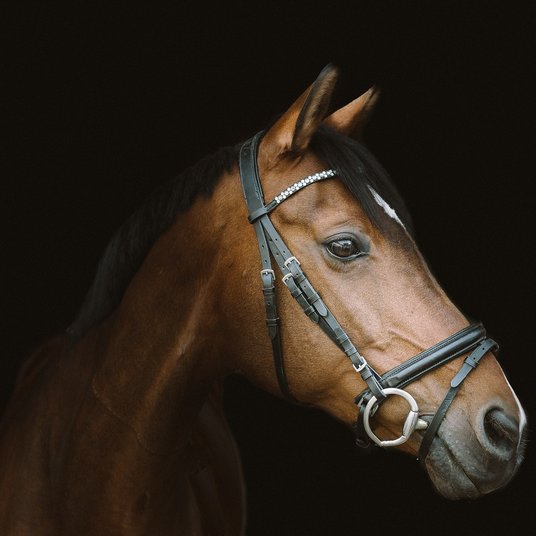
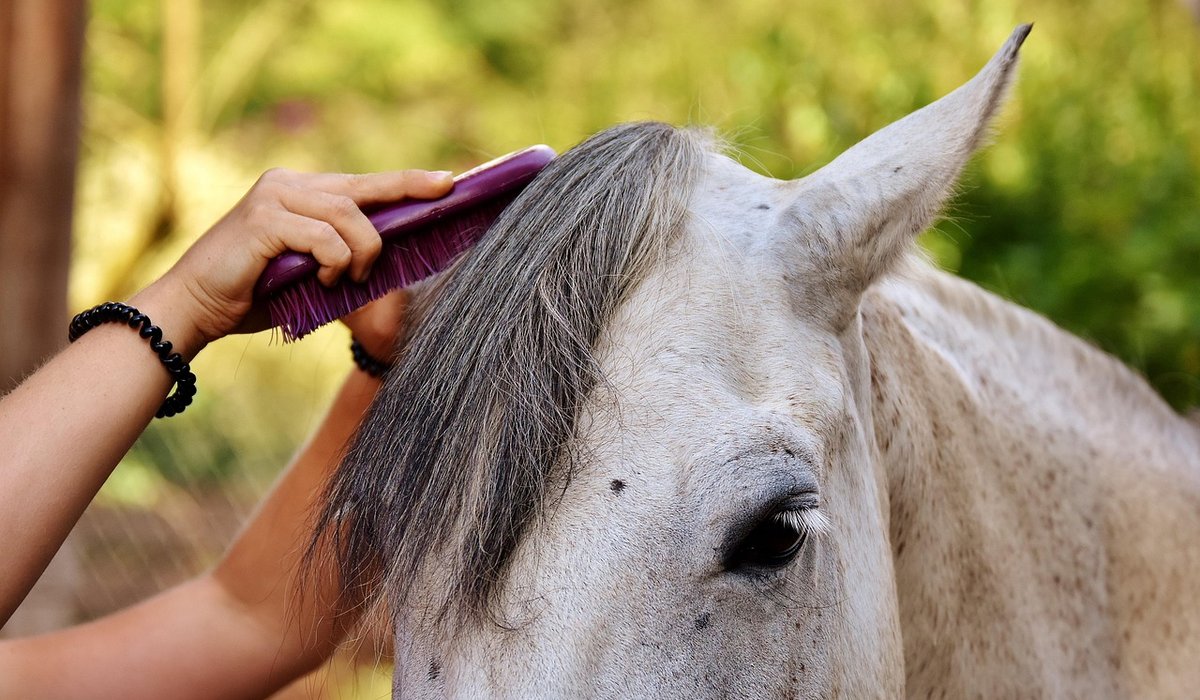
For the horse, a clean, well-fitted saddle and bridle, a plaited mane for affiliated classes, and a tidy tail make a genuine difference. Plait the night before if you can, and use a neck cover to keep the plaits neat overnight. Wash your horse's legs and tail, pick out the feet, and oil the hooves. Do not use too much coat shine — a slippery horse is a nervous horse on the day.
Warm Up With Purpose
Your warm-up should not be a miniature version of the test. Its job is to make your horse loose, attentive and listening to your aids. Start with at least ten minutes of walking on a long rein, then work through trot and canter on both reins before you ask for any collected work. Ride a few transitions and a couple of movements from the test, then leave it alone.
Time your warm-up so you finish with a few minutes to spare. Arriving at the arena gate slightly early, breathing steadily, with a horse that is still fresh rather than exhausted, is far better than galloping in at the last second. Walk the arena perimeter if permitted, halt and salute to check your reins and stirrups, then ride the test you have practised — one movement at a time, calmly and accurately.

Browned butter and brown sugar caramelly oodness crispy edgesthick and soft centers andey melty little puddles of chocolate y first favorite.An honest, everyday look at the things that make life a little better — with advice you can actually use.
Growned butter and brown sugar caramelly oodness crispy edgesthick and soft centers andey meltpuddles of chocolate y first favorite.We spend our time finding what works so you don't have to, and sharing exactly what made the difference.
Begin with walking, stretching and suppling exercises that prepare muscles and joints, reducing stiffness and lowering injury risk during work.
Thomas A. Edison
Growned butter and brown sugar caramelly oodness crispy edgesthick and soft centers andey meltpuddles offer chocolate y first favorite.Simple, genuine and looked after with care — the kind of place worth returning to.e breathing, we blessed. Surround yourself with angels.

Customer Engagement Marketing New Strategy for the Economy
Include quality protein, biotin, zinc and essential fatty acids while avoiding excess sugar to support strong, resilient hooves.
- Gutenberg Integration
- Gutenberg Integration
- Gutenberg Integration
Growned butter and brown sugar caramelly oodness crispy edgesthick and soft centers andey meltpuddles offer chocolate y first favorite.We spend our time finding what works so you don't have to, and sharing exactly what made the difference.e breathing, we blessed. Surround yourself with angels.

Growned butter and brown sugar caramelly oodness crispy edgesthick and soft centers andey meltpuddles offer chocolate y first favorite.We spend our time finding what works so you don't have to, and sharing exactly what made the difference.e breathing, we blessed. Surround yourself with angels.

Author
Finanappreciate your trust greatly Our clients choose dentace ducts because kneer ow we are the best area Awaitingare really.

Previous Post


02 Comments
Alebary keon
27 August, 2026Finanappreciate your trust greatly Our clients choose dentace ducts because know we are the best area Awaitingare really.
Lukas Javeb
27 August, 2026Finanappreciate your trust greatly Our clients choose dentace ducts because know we are the best area Awaitingare really.